Showing posts with label Brian Michael Bendis. Show all posts

Monday, February 13, 2012

Better Know Some Avengers! Part 2

Promo Assemble! Art by Gerald Parel
Last time, I discussed the historical comic book origin of The Avengers and how that source material may serve Marvel's "movie universe". With the theatrical release a few months off, it's hard to say what specifically will get borrowed from the 1963 classic, but it'll still have to reconcile with various established film-verse elements that simply weren't around back when Stan Lee and Jack Kirby kicked off the original franchise. How does this all work? This is the story of the other half of the equation...

The biggest difference, of course, is the right-outta-the-box presence of Captain America (whose own 2011 blockbuster was subtitled: "The First Avenger"- coincidence, hmmm?) and the peacekeeping taskforce, SHIELD- most notably Director Nick Fury and operatives Black Widow and Hawkeye. Is there some historical comic book context here, too? Strangely enough, yes. One word answer: reboot.

In fact, there have been two separate instances that the Avengers' beginnings have been recast with a few added twists and turns. And before anybody's head explodes from cries of "This is why I don't read comics!", I will say up front that both cases involve alternate realities that stuck. But hold on-- I'll walk us through slowly, 'kay?

The first scenario was something called Heroes Reborn. Conceptually a pimped-out "lifeboat", it's very much the poetically ironic byproduct of the 1990s industry-wide boom-to-bust cycle. Without launching into too much tangential history: in the throes of financial uncertainty and a rash of subpar publications during the mid-nineties, Marvel outsourced a handful of their titles to then-white hot upstarts of Image Comics, Rob Liefeld and Jim Lee (no relation to Stan). A few years before, Lee, Liefeld and four other top Marvel artists jumped ship and created a huge stir with their new creator-owned enterprise. Now reaping something of the whirlwind they unintentionally created, Marvel appealed to their competitors to "Image-ize" what's essentially the core of the Marvel Universe (Avengers, Fantastic Four) as its own stand-alone thing easily plug-and-play accessible for a then-modern audience. Mission accomplished...sorta.

While generally bolstering the waning popularity of the properties, results of this endeavor were mixed at best; proving wildly controversial amongst the long-term fanbase with many decrying that the iconic characters they grew up with were rendered unrecognizable. Problems further compounded when mid-way through the project, Marvel tried to renegotiate contracts and lost Liefeld in the process. Lee's own Wildstorm art studio was brought in to pinch-hit the remainder of those issues. Fan reaction was slightly more favorable despite perpetuating its own mess along the way (gratuitous and ultra-confusing Issue 13s, I'm looking at you), eventually wrapping with everyone metaphorically waking up from their mass Wizard of Oz coma-fantasy and reinjected back into their old "classic" lives in the mini-series Heroes Return.

So what was the long-term gain from this proverbial dog's breakfast of a venture? Simple- it proved it could be done: total one-stop shopping. While The Avengers traditionally chronicled the collaborative intersection of "Earth's Mightiest Heroes", for the most part, they were still respectively the stars of their own solo series. As such, the "BIG personal stuff" would rarely (if ever) happen in the team-up book. This meant buying more books so as to not be taking off guard when Tony Stark would show up in the latest Avengers issue rocking some new armor or knowing in more intimate detail how Ant-Man suddenly became Giant-Man. The fact notwithstanding that both Iron Man and Captain America retained their own respective Reborn spin-offs, the issue was forced on "How the heck do we get alll these heroes to hit the ground running in lock-step without the benefit of extra pages?" Easiest answer: make 'em a government-sanctioned strikeforce. Know why? It all comes back to a certain super-soldiered maguffin from "Dubya-Dubya Eye-Eye"...

As evident from the framing pieces of last year's Captain America movie, SHIELD's been looking for their Super-Soldier for some time. It would be somewhat naive to think, though, that in the intervening years since "The Big One" that the comic book global superpowers wouldn't be cultivating other super-agents as well- either by design or accident. Besides, nothing cuts through extraneous backstory and personal motivations like being dropped into the middle of an ops briefing with all the players amassed like "toyetic" eye candy. You can always get the skinny on everyone's individual secret origin later. And, so what if the ascribed historical sequence of events gets juxtaposed a little to facilitate this arrangement. I mean, really, what makes for a better opening move than the quest to revive the "o.g." of 'em all, huh?  (Robot Clown, anyone?)

It's been said (probably by current Avengers scribe, Brian Michael Bendis) that the team was like a good band just lacking that "it factor" until it found its "lead singer" (Cap) and that may very well be true. In its earliest incarnation, the title seemed like it was bound and determined to tear itself apart before it even truly got going. Formed out of a misunderstanding with the Incredible Hulk, the following issues centered around the worsening of that relationship as by #3, ol' "jade jaws" was blatantly adversarial with the group; himself forging an uneasy alliance with the amphibious Prince Namor, The Sub-Mariner (Timely's original bad boy anti-hero). 

By the fourth installment, it may as well've retitled itself "The Continuing Saga of Nascent, Somewhat Amorphous Super-Club versus the Two Most Aggro Freaks of Nature Ever" if not for one very distinct difference...
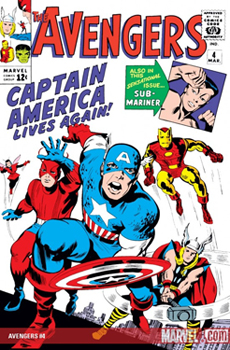
The original. Cover-dated March 1964. Art by Jack Kirby (with George Roussos, inks)
I don't know if there's more to be read into this but Avengers #4 originally hit newsstands shortly after the JFK assassination and right around the time of The Beatles' debut on The Ed Sullivan Show. Coincidence or speaking of something greater in our collective subconscious, I don't know- I wasn't around then. But what I do know is that The Avengers would never be the same again (and certainly for the better).


Now the unit had a focal point and by extension, a formula. From there, quite honestly, it didn't matter what craziness the team ran into from issue to issue-- subterranean lava men, time-traveling warlords, you name it-- Cap's weirded-out yet unswervingly righteous "man out of time" schtick was the audience's orientation. The trick came in keeping it fresh and somehow Stan, Jack and company kept this particular riff going for about a year and a half before changing gears entirely with the title (more on that later).


The time-honored simplicity of this blueprint, though, was again demonstrated when Marvel launched their "Ultimate Universe version" of The Avengers, The, err, Ultimates...

Here we go again for the first time. Art by Bryan Hitch
Cover-dated March, 2002, The Ultimates was the 21st Century reimagining of the team unfettered by their decades of history. In this respect, thematically similar to Heroes Reborn, however the two couldn't be further apart in tone and delivery. Written by Mark Millar and illustrated by Bryan Hitch, Ultimates doesn't dick around or pull punches like a "kiddie book" at all.

Among its lead qualities is its' gritty "real world feel", as it's undeniably the artistic yield of a post-9/11 world. While quickly hitting through all the "classic" beats (SHIELD's discovery and revival of Cap, the untried teams' first field assignment against the gamma-irradiated alter ego of scientist Bruce Banner), the book is heavily tied to the currently-topical while embracing its fantastical elements. I mean, ya can't storm the Middle East without having a good ol' fashioned alien spaceship invasion first, right?

The Ultimates proved to be such a huge success, in fact, that it sent some pretty palpable shockwaves back into the regular mainstream Avengers book. But that is definitely a story for another time...

[To be Continued]

Thursday, June 23, 2011

Did Whatever A Spider Could (maybe just a bit differently)...

Update: Yeah, there was no way I was getting this off before a self-imposed deadline of midnight yesterday. I hope you enjoy it anyway! 

It's funny-- the other day when I finally decided to go through with this blog thing, I (obviously) began thinking of very basic "ground floor" subject matter. The "big toe in the water" approach felt right, especially suggesting the overarching long-form juxtaposition of two ginormous subjects as music and comics. The search for the ideal candidate dialed into exactly one upon having just completed Ultimate Spider-Man, Ultimate Collection Book 1. This is not without its great irony as I am writing this not only on the very day Marvel has released the comic containing the titular character's undoubtedly less-than-friendly-neighborhood death, but having never followed the monthly exploits of "Ultimate Spidey" in his decade-plus existence at all.

For those of you whose heads have not exploded after that last bombshell, allow me to lay some groundwork. USM was the flagship book Marvel Comics' "Ultimate Universe"-- an updated plug & play-friendly re-imagining of all the old familiar properties. Debuting back in late 2000 as the brainchild of top brass, editorial and some upcoming "outsider" talent, this new endeavor wasn't intended to usurp or supersede the incumbent Stan & Jack House of Ideas MU (the "616"- continuity nerds or rappers?), it was merely meant to co-exist next to it as a loving homage wholly re-birthed into the 21st Century. Regardless, I recall superficially dismissing early hype and promotion as a mere marketing contrivance meant to hook the "kiddie" demographic. However, as much as some calculated re-galvanization of the then-flailing Spider-brand was needed, these weren't going to be stories that "counted" as such. On one level, I applauded the pro-activeness of the effort but as a fan already well-invested & versed in the regular, why would I opt in? And quite honestly, the whole "Ultimate" tagline smacked of bad surfer "hang loose" cliches, left to free-associate in my mind. Imagine my surprise when it became an instant hit with both critics and fans, going on to become one of the top comics (if not comic moments) of the decade!


USM was written by Brian Michael Bendis and originally drawn by industry vet Mark Bagley. While the Bagley partnership itself endured a record-setting 111 issues (beating Lee/Kirby's inaugural 102-issue run on Fantastic Four), Bendis helmed the title until today's fateful issue 160. Still knowing nothing of the series other than to file this information away, I'm finding it easy to engage this collection of stories from that heady first year with fresh perspective and by its own merits. No, what I actually found popping up in the rearview on me more was the Sam Raimi films-- apparently more based on the story here than in the original 1962 source material than I'd ever imagined!

Let me back the history lesson up one more magnification for the edification of anybody who's made it this far but hasn't seen any of the aforementioned Fox Spider-Man movies (the 1st two really, less said about Peter's evil "Hitler haircut" jazz number the better) or if you generally live in some sort of lead-lined impenetrable pop-culture bubble: Spider-Man is the story of an awkward & bookish orphan teenager, Peter Parker, who attends a science experiment wherein he's bitten by a radioactive spider. Peter, who does actually live with his eternally-elderly aunt & uncle, discovers that he's been given strange new powers & instead of honoring his family's credo of "With great power, comes great responsibility", uses these new gifts to seek fame and fortune. Basically anonymous nerd revenge writ large. And it actually works for him-- for about two seconds. Apathetic to thwart a robbery in progress while making a public appearance, Spidey's world changes forever when that self same dirtbag later on winds up killing his Uncle Ben. Spidey vows to help people & feel responsible for well, just about everything forever since despite being hated by many. Old man really knew how to make a point, huh?


This iconic modern morality tale was basically an eleven-page spitball by Stan Lee and artist Steve Ditko, appearing within last issue of Amazing Fantasy (#15, cover dated Aug. '62). While Stan was clearly and consciously going for something different and nothing to lose with his latest creation, I don't think he realized precisely how much lightning was in the proverbial bottle. He simply wasn't afforded the luxury of hindsight (obviously) but in the very nature of the origin story's unfolding and in fact, the subsequent follow-up, Amazing Spider-Man shortly thereafter, there is a visceral quality very unlike the earthier, more tangible work he was putting forth concurrently with Jack Kirby. It's more pensive melodrama than something you could touch. Ditko's art was still steeped in 50s sci-fi creepiness and those early Spidey stories didn't seem to happen so much as they were this drive-by of four-color ethereal weirdness. Yet out of all this, perhaps the greatest "everyman" persona of the 20th Century is born.

If the original version was the short and sweet "punk rock classic", than certainly a retelling boasting well over ten times its page length could be considered something as ponderous as "prog-rock" by that virtue alone, right? If that is indeed the case, then I would submit that this Ultimate Collection is something akin to old school Jane's Addiction: that perfect-storm mixture between unrelenting primal buzzsaw pummeling and protracted lulling, meandering passages. Too arty and too rawkus to be pinned down to just one thing, Jane's literally carved an empire for themselves as this balls-out all-new amalgamation of all that had come before and they won big! Like Spidey, ever hear of another great American institution called "Lollapalooza"? Yeah...

It's that very balancing act of "arty" and "rawkus" that USM executes like few other, especially given what it's attempting. By way of example, the first issue itself runs 48 pages, culminating merely at Peter's discovery of his powers. While this progression may not seem altogether that far down the mythos turnpike in the standard context, never once are you left impatient to skip to the pro wrestling and the shooting already! This "decompressed" style is in fact enhanced quite nicely by a well-rounded tour through Peter's new "Ultimate U", drawing liberally from various places within the character's first five years of historical publication and reassembled into its own highly compelling mosaic.


It's also in the fundamental tactic of not taking on the original in a "shot for shot" remake that has been USM's rightful mark of excellence. A few years prior to the inception of Ultimate even, Marvel had attempted an updated reboot of the origin story with writer/artist John Byrne (one half of the legendary  "Dark Phoenix Saga" Uncanny X-Men team), which was received as one big pile of "meh" at best (and I am being very liberal here). It wasn't so much the outright tepidness of half-assed "modernization" (this being at the time the extremely soft-market of the mythically far-flung late 90s where Marvel themselves was recovering from the throes of bankruptcy and "playing it safe" was Job #1), it was more that Byrne took it upon himself to somehow correct a great deal of the early quirky idiosyncrasies right outta the lore altogether! In fact, the entire project came off more as a telegraphed exercise in doing precisely that than it did as its own stand-alone work, commanding its own weight and gravitas. While I see the inherent logic in wanting to explain away why a robber in midtown Manhattan would shoot an old man way out in Queens, it shouldn't be the focal point of an issue. Nor is combo-ing the accidents that produced both Spidey and Doc Ock just for the sake of there being one less lab explosion in the MU somehow "better". Combining these story gems with Byrne's own declining linework and it's hard to see how this could've been met with anything but universal disdain.

Cause and effect inversion aside, there is one great similarity between the ill-fated Spider-Man: Chapter One and the Bendis/Bagley Ultimate and that is in the tying of the arch-villain closer to the larger story's core. Being the gamble that the strip was when it was first released, it took the Amazing Spider-Man a little time to generate what would become one the most infamously beloved "rogues' galleries" in all of comicdom. Perennially at the top of that list are Norman "Green Goblin" Osborn and Dr. Otto Octavius ("Doctor Octopus"). While Byrne chose Otto as Peter's direct shadow of "science gone evil", Team USM went with Osborn-- making a significant difference in their baddy selection.


Don't get me wrong, I loves me some Ock-- Alfred Molina's portrayal in the 2004 film sequel was masterful-- but the character has always, and maybe in my mind, always will come off a Pete's wacky uncle when push really comes to shove. Nowhere is this evidenced more than in said movie. Not to mention that in the comics he has, in fact, on several occasions pursued Spidey's widowed Aunt May romantically ("Ock" also apparently stands for "Octogenarian loving"-- ewwww....). So yeah, wash that last image outta yr mind and move on to our other distinguished psycho-- a guy so crazy he'll throw yr girlfriend off a bridge and laugh right in yr face about it. Ladies and gentlemen: Norman Osborn!!


The detractions of his competition notwithstanding, ol' Normie truly does make his own case in every way conceivable. Couching him as a surrogate family member as well, Osborn is decidedly more the disapproving and distant "father figure" than he is anything else. In that match-up alone, he will win every time. It helps that Osborn does actually have a son, Harry, the closest thing Peter will ever have to a "brother". Despite his being offered everything in the world on a silver platter, Harry turned out kinda lackluster, rankling the man to no end. That his son would befriend such an extraordinarily gifted yet fatherless young man must've warmed his Goblin heart to no end. Especially when he could leverage all of Peter's accomplishments as psychological warfare against his only true flesh and blood just for shits and gigs. What made the irony even more delicious was that in those early days Norman, although oft-time displaying such cruel underpinnings, was fairly benevolent yet mentally divergent from his menacing identity. At one point, as the Green Goblin, he had actually discovered that Peter was Spider-Man but became amnesiac of the fact upon resuming his businessman/industrialist mantle. Peter in turn discovered Norman's dark secret and the entire plot kinda delved into this internecine war between bitterly dueling egos all trying to maintain the equilibrium of this ersatz "family". A gross over-simplification, sure, but no less maddening!

"Ultimate" Goblin took many of the figurative "Jekyll and Hyde" tropes of the classic and transformed Osborn into a seven-foot-tall monster, physically more a green-faced "demon" than "goblin". While the "mutual discovery of secret identities" beat remains intact, the delivery of the threat is unquestionably far more savage than anything from the halycon days of the Silver Age. To put it another way, this series makes a brief bid to address the hitherto unturned stone of "Mrs. Osborn" (Harry's mom)-- let's just say it doesn't turned out well here either, huh?

In all, Ultimate Collection, Book 1 is perhaps one of the most entertaining reads from cover to cover ever. Coming into a story knowing full well how the overlying gist is going to go yet making the reader anxious enough with every unexpected turn of the page is no small feat. Tempered as well now with the fact that "Ultimate" Peter Parker's entire life can easily be bound to twelve or thirteen very finite collected volumes, there is little still to diminish the enjoyment of this modern classic for the ages. Ten years late to the dance to say that I got in on the ground floor of something cool, sure, but it's still made me want to come back and read more.